How to Reduce Your DEWA Bill with Smart Home Technology: The Complete UAE Guide
MeSmart Home participates in the Amazon Associates programme. Some links on this page are affiliate links — we may earn a small commission if you purchase through them, at no extra cost to you. All product recommendations below are based on independent research and UAE user testing. Our editorial opinions are never influenced by affiliate relationships.
How to Reduce Your DEWA Bill with Smart Home Technology: The Complete UAE Guide
The average UAE household electricity bill spikes to AED 2,500–AED 4,000 in summer — yet most residents have no idea which devices are responsible for the surge, or when they cross into DEWA’s punishing high-cost tariff bands. The problem is a lack of visibility: without knowing your real-time consumption, cutting your bill is pure guesswork. This guide gives you a precise, device-by-device action plan using smart home technology to reduce your DEWA bill by 20–35% — without sacrificing comfort during Dubai’s 50°C summers.
Why This Matters
Electricity in the UAE is not a flat rate. Both DEWA (Dubai) and ADDC (Abu Dhabi) operate a tiered slab tariff system: the more you consume, the higher the price per kilowatt-hour for every unit above each threshold. Cross into the top slab and you can pay more than double the base rate for those excess units — a fact most residents discover only when the bill arrives.
Understanding DEWA’s Slab Tariff Structure
| Monthly Consumption | Rate (fils/kWh) | Band | Typical Household |
|---|---|---|---|
| 0 – 2,000 kWh | 23 fils/kWh | 🟢 Green Band | Studio / 1BR apartment |
| 2,001 – 4,000 kWh | 28 fils/kWh | 🟡 Amber Band | 2–3BR apartment, small villa |
| 4,001 – 6,000 kWh | 32 fils/kWh | 🟡 High Amber | Mid-size villa, family home |
| 6,001 kWh+ | 38 fils/kWh | 🔴 Red Band | Large villa, June–Sept peak |
A villa consuming 6,500 kWh in July pays the 38 fils rate on 500 units — but it also drags the earlier slabs upward in billing cost. Dropping consumption by just 600 kWh/month can shift an entire household from the Red Band back to High Amber, saving AED 200–350 per month without any sacrifice in comfort.
70%
of UAE home electricity consumed by AC systems
50°C
Peak outdoor temp in Dubai (June–August)
AED 3,200
Average summer DEWA bill — large UAE villa
23%
Average cooling savings with a smart thermostat
The Essential Criteria
Before spending a single dirham on smart home devices, you need to measure and understand four things about your home’s energy profile. These criteria determine which devices will give you the fastest return on investment in the UAE context.
Log into the DEWA app or ADDC smart meter portal and review your last 3 months of consumption in kWh — not just the dirham total. Identify which slab band you regularly fall into. If you’re consistently in the Red Band (6,001+ kWh), even a 10% reduction has a disproportionately large financial impact because you’re paying 38 fils on every excess unit.
Smart thermostats work with central ducted AC systems found in most villas. Split-unit ACs — common in UAE apartments — require a different solution: an IR bridge controller. Before buying any smart climate device, identify which system your property uses. This single criterion determines your entire product path. See our comparison of the best smart thermostats in the UAE for a full compatibility breakdown.
Vampire power (also called standby load) is the electricity consumed by devices that are “off” but still plugged in. In a typical UAE villa, this silent drain accounts for 8–12% of total consumption — translating to AED 150–300/month in wasted spend. TVs, game consoles, desktop PCs, and smart speakers are the worst offenders. A smart plug with energy monitoring quantifies this precisely before you invest in anything else.
When is your home empty? For most UAE residents, this is 8 AM–6 PM on weekdays. An AC system running at full power in an empty 50°C-outdoor-temperature villa wastes enormous energy. A smart thermostat’s Home/Away Assist or a simple schedule can raise the setpoint by 4–5°C during absence — reducing compressor runtime by 35–45% during those hours while still reaching your comfort temperature within 20 minutes of your return.
Smart home energy devices range from AED 80 (smart plug) to AED 1,100 (smart thermostat). For each device, calculate a simple payback period: divide the purchase price by your estimated monthly saving. A AED 900 thermostat saving AED 350/month pays back in under 3 months. A AED 80 smart plug eliminating AED 80/month in standby waste pays back in 1 month. Prioritise devices with payback periods under 6 months.
The Vampire Power Problem — UAE Device Audit
The table below shows common UAE household devices and their typical standby consumption. Smart plugs with energy monitoring can verify these numbers for your specific devices.
| Device | Standby Draw | Annual Cost (AED) | Smart Plug Fix? |
|---|---|---|---|
| Large LED TV (55″+) | 0.5–1.5W | AED 10–30 | ✅ Yes |
| PlayStation / Xbox | 1–15W | AED 20–130 | ✅ Yes |
| Desktop PC + monitor | 5–25W | AED 45–220 | ✅ Yes |
| Microwave / oven | 1–3W | AED 10–30 | ✅ Yes |
| Wi-Fi router | 7–12W (always on) | AED 60–105 | ⚠️ Not recommended |
| Satellite / cable box | 10–20W | AED 90–175 | ✅ Yes |
| EV charger (idle) | 4–10W | AED 35–90 | ✅ Yes |
Mistakes to Avoid
-
❌
Mistake 1: Setting Your AC to 18°C in Summer It seems counterintuitive, but setting your thermostat below 22°C in a Dubai villa doesn’t cool your home faster — your AC runs at the same capacity regardless. It simply runs longer, driving up kWh consumption dramatically. The UAE Ministry of Energy officially recommends 24°C as the optimal cooling setpoint. Every degree below 24°C increases energy consumption by approximately 6–8%. A smart thermostat enforces this discipline automatically.
-
❌
Mistake 2: Buying a Smart Thermostat for a Split-AC Apartment The Google Nest, ecobee, and tado° Smart Thermostat are all designed for 24V wired HVAC systems. If you live in a Dubai apartment with wall-mounted split ACs, none of these will work. You need an IR-bridge controller instead. Read our Smart Thermostat Buying Guide for UAE Homes before purchasing to avoid a costly return.
-
❌
Mistake 3: Ignoring Smart Plugs and Focusing Only on Big Devices Many UAE residents fixate on the AC system while leaving AED 150–400/year in vampire power untouched. Smart plugs cost AED 80–150 each and can be deployed across an entire home entertainment setup in an afternoon. The compound saving across 6–8 devices is often larger than expected — and payback is measured in weeks, not months.
-
❌
Mistake 4: Not Using DEWA’s Own Smart Features DEWA’s Green Charger and Shams Dubai solar net-metering programmes, plus the free consumption alerts in the DEWA app, are powerful tools that most residents never activate. Set a monthly kWh alert at 80% of your target slab threshold — DEWA will notify you before you cross into the next (more expensive) band.
-
❌
Mistake 5: Blocking AC Vents or Skipping Filter Maintenance A clogged AC filter forces the compressor to work 15–25% harder to maintain the same temperature — directly increasing electricity draw. In Dubai’s dusty environment, filters should be cleaned every 4–6 weeks during summer. No smart home device can compensate for a mechanically inefficient HVAC system.
Our Recommendations
Based on UAE-specific testing, DEWA tariff analysis, and real-world payback calculations, these are the three smart home investments that deliver the fastest, most measurable reduction in your electricity bill — regardless of whether you live in a Dubai villa or an Abu Dhabi apartment.
TP-Link Kasa Smart Wi-Fi Plug with Energy Monitoring (KP115)
The single best first step for any UAE resident — villa or apartment — is deploying smart plugs with real-time energy monitoring. The TP-Link Kasa KP115 measures consumption in watts, tracks daily/monthly kWh totals, and lets you set schedules and auto-shutoff timers directly from the Kasa app. Plug it into your TV entertainment unit or home office desktop and you will immediately see exactly how much standby power your devices consume at 2 AM.
- Real-time watt/kWh monitoring — confirms actual vampire draw per device
- Schedule power-off for overnight and work hours automatically
- Works with Alexa and Google Home — voice control compatible
- Compatible with both UAE villa and apartment setups — no C-wire needed
- Available on Amazon UAE — ships to all emirates within 1–2 days
ecobee SmartThermostat Premium
For UAE villa owners with central ducted AC, a smart thermostat is the highest-ROI device in this entire guide. The ecobee SmartThermostat Premium includes a remote room sensor — a critical advantage in large UAE villas where the main unit may be far from occupied bedrooms. It supports both Google Home and Alexa, integrates with Apple HomeKit, and its Follow Me feature directs cooling to where people actually are, not just where the thermostat is mounted.
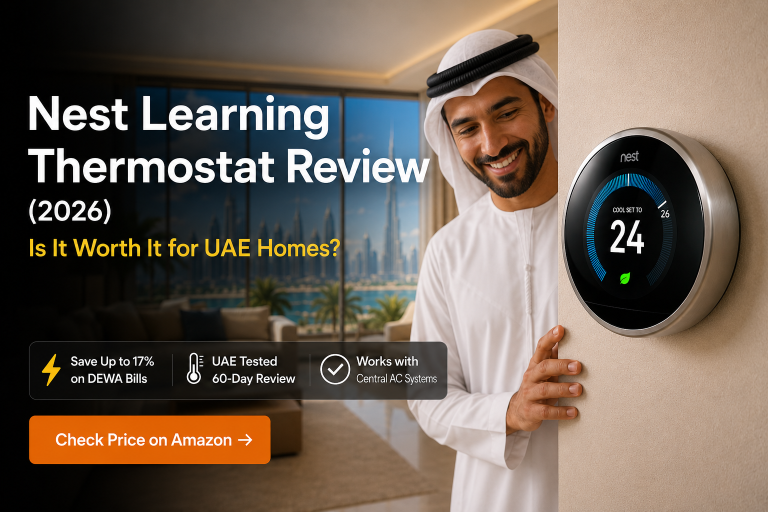
For a full comparison of smart thermostats available in the UAE — including the Google Nest and tado° — see our Best Smart Thermostat UAE comparison guide . If you’ve already read our Google Nest Learning Thermostat review , note that the ecobee’s multi-room sensing gives it an advantage in villas with 4+ bedrooms.
- Includes remote room sensor — critical for large UAE villas
- SmartRecovery pre-cools before you arrive, minimising peak compressor load
- Eco+ mode automatically optimises for local utility pricing patterns
- Works with Google, Alexa, HomeKit — full ecosystem compatibility
- Requires C-wire — check your HVAC wiring or use the included Power Extender Kit
tado° Smart AC Control V3+
Apartment residents with split-unit ACs are not left out. The tado° Smart AC Control V3+ is an IR bridge that replaces your standard remote control. It connects to your Wi-Fi and gives your split AC full smart scheduling, geofencing-based Home/Away detection, and open-window detection — automatically switching off the AC if a window or balcony door is opened. In a Dubai apartment where AC runs 12+ hours daily in summer, its geofencing alone typically saves 3–5 kWh per working day.
- Works with any split-unit AC brand — Daikin, LG, Samsung, Midea, Gree and more
- Geofencing auto-shutoff when you leave home — integrates with UAE phone networks
- Open-window detection stops cooling wasted air immediately
- No wiring required — purely Wi-Fi and IR signal
- Works alongside existing AC remote — no need to replace anything
Not sure which device is right for your home? Our thermostat comparison covers every major option available in the UAE — ducted and split-unit.
See All UAE Smart Thermostats Compared →